Death: A Crazy Whirlpool

Gone. Gone. Gone. Covering this topic forced me to take a deeper look into the harsh reality that surrounds death. This occurrence comes along with multiple strings attached like grief, anger, acceptance, and cold-hearted pain. One cannot begin to understand the pain of loss, when loss has not been felt, and one can not understand suicide victims when the thought process of suicide has not been felt. Although this topic was dark and gloomy, the few upsides seemed to peek through with the help of our guiding stories. Dylan Thomas’s “Do not go gentle into that good night” and Andrew Hudgin’s “Elegy for My Father, Who Is Not Dead” help to perceive the deep and multitude of ways that the occurrence of death can go. While one story describes the strong yearning for not wanting a loved one to perish just yet, another takes a closer look in one of the many ways that death can be interpreted. It can be incredibly breathtaking to imagine a closed loved one perishing or even wrap my head around myself dying one day. When we are young, we think death is inevitable and it is untouchable to us. While looking deeper into this theme, I came to the self realization that death has no age, no race, no color, and certainly no time.

Dylan Thomas’s “Do not go gentle into that good night”, gives the internal battle that one might be fighting. This story that we took a closer look into, was a son who throughout the entire story is hoping that his father will fight not to die. The author gives us a major hint like “Rage, rage against the dying of the light” (Thomas 1), to help us understand how badly he does want his father to stay alive. There is only so much that loved ones can do while watching a close loved one pass away. We can do many things like pray, send love, sing, and even wish. But will any of those things really work? What exactly does one do when a loved one is hanging onto life by a thread? In my opinion, the only option that is left, is hope. You can hope that somewhere in their mind, they are fighting to come back to earth and be with the family they will be leaving. Much like the son in the story who is hoping with all his heart that his father will not die, thousands of people are experiencing the exact same mental process of hoping. When science can only go so far and prayer can only go so far, all that is left to do is hope. Hope with all of our hearts.

Andrew Hudgins’ “Elegy for My Father, Who Is Not Dead”, dives straight into another form of death that society does not often acknowledge. When you want someone to be metaphorically dead as in gone, that to me just sounds like a whole lot of family drama. The story follows as a child of a father who maybe was not always present and did not have the best parent-child relationship. A child who is know much older according to the story and is hoping to one day get a phone call that their father is dead. We do not get too much insight into why the relationship is so damaged and what exactly went wrong according to the child’s side. However, quotes like “He’s ready” (Hudgins 1), gives us a major clue into the sureness of  their father’s death. Personally, it was really hard to understand where the child is coming from because I could never imagine wishing that one of my parents would die already. I guess that it all depends on the extent and the magnitude of what the parent did or did not do. I believe in forgiveness and after a period of healing, finding the strength and hope to forgive them. A really important thing that this topic about death taught me, was to value the family that I have now and never forget the room for forgiveness and the endless possibilities of love.

Word Count: 689 words

Works Cited

Hudgins, Andrew “Elegy for My Father, Who Is Not Dead”, 1987

Thomas, Dylan “Do not go gentle into that good night”
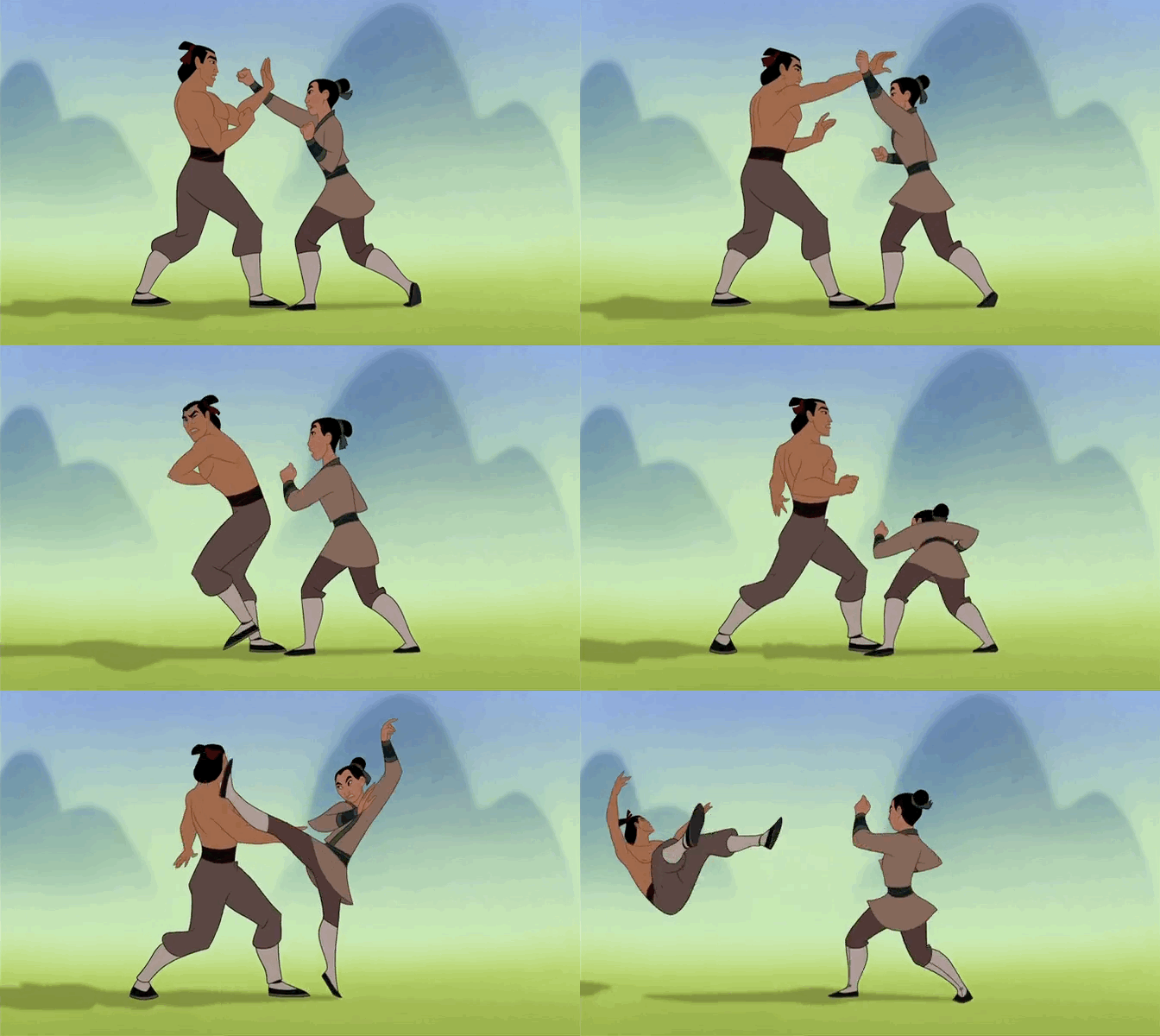
Gender Conflicts: The Struggle is Real

Image result for man fighting woman gif
https://www.google.com/search?biw=1138&bih=543&tbm=isch&sa=1&ei=C122XOrMN4n0tAWNobGgBw&q=man+fighting+woman+gif&oq=man+fighting+woman+gif&gs_l=img.3..0i24.55651.60329..60636…0.0..0.117.995.6j4……1….1..gws-wiz-img…….0i67j0j0i7i30j0i5i30j0i5i10i30j0i8i30j0i7i5i30.hAWMy14-UU8#imgrc=ataTf9xtaM9MCM:

Gender conflicts was a challenging theme that put a reminder on just how difficult twenty first century relationships can be. Ranging from romantic to work relationships, there are many barriers or difficulties that have been often times discovered. The gender conflict realm is a broad topic that opens up much controversy and discussion on the specific issue of the negative treatment of women. Deborah Garrison’s “ Please Fire Me” touches on the extreme difficulty of being a women in the workplace in today’s current environment. Probably only a couple of decades from ago, being a woman in the workplace was absolutely prohibited and it was difficult for women to find a job other than being a housewife. Flashforward to present day 2019, women can work! However, they are still facing much sexual harassment and male dominated higher ups that are not always aware of equal treatment. Margaret Atwood’s “You Fit Into Me”, in my opinion clearly represents the often difficulties that can arise in a romantic relationships. Two people can look amazing together but that is only the surface. Personality’s between a man or women can be so different that it will not make a relationship work and it will completely crash and burn. There are conflicts and issues all around the world but when dealing with gender conflicts, always bring a weapon to the fight and pick a side.

Deborah Garrisons “ Please Fire Me”, lights the fire on the discussion of how women are being treated in the workplace. In the story we have a women who is finding it difficult to stay in her job and not quitting. She is surrounded by male co- workers and bosses who spread their masculine power around voicing any opinion they please. On the other hand, she is almost forced to stay quiet because of the male dominated workplace and if she was to speak up, perhaps there would be some type of consequence in her case. The current workplace environment between men and women is not so equal as it absolutely should be in terms of equal treatment. Of course women are progressing and have more freedom than previous years however, that does not mean that discrimination is completely gone. The fact that women still have to feel fear at a place that is solely for work is out of this world! Fear to say how they really feel because it could result in determination and of course everyone needs jobs. This is one of those conflicts between men and women that will never go away. Unless men decide to finally hide away their male chauvinism and become considerate to every women young and old they meet.

Image result for scared woman gif
https://www.google.com/search?biw=1138&bih=543&tbm=isch&sa=1&ei=Sl22XMCqBdCwtgWX-qjYCw&q=scared+woman+gif&oq=scared+woman+gif&gs_l=img.3..0j0i8i30l2.112199.126601..127214…0.0..0.120.1271.8j5……1….1..gws-wiz-img…….0i67j0i10i67j0i7i30j0i8i7i30.MI8lbDcwauc#imgrc=LoqB01a1FHzskM:

Margaret Atwood’s “You Fit Into Me” gave a vivid, but short way to describe romantic relationships today. I perceived this as toxic relationship. It first starts off on a light and intimate tone. Then, the second line takes it to a more chilling tone. “Like a hook into an eye” (Atwood 1). This is definitely an unusual way to describe a relationship and is a painful use of a metaphor. Then, Atwood goes forth to say “a fish hook an open eye” (Atwood 1). This is further detailing their relationship as something that is harming both of them. They both know this is happening as it states that the eye is open, meaning aware of the situation. They both continue to take part in the relationships for reasons unknown, but it seems to be something that is unhealthy and real in this current era.

Image result for broken heart gif
https://www.google.com/search?biw=1138&bih=543&tbm=isch&sa=1&ei=iF-2XN7QNIzktQXMvav4Ag&q=broken+heart+gif&oq=broken+heart+gif&gs_l=img.3..0j0i7i30l9.8517.13920..14040…0.0..0.143.1276.4j8……1….1..gws-wiz-img…….0i67j0i7i10i30.y-cbwVTuWW0#imgrc=17Q6V_MOT-RQCM:

Word count: 605

Works Cited

Atwood, Margaret. “You Fit Into Me”

Garrison, Deborah. “Please Fire Me”

Power & Powerlessness

See the source image
https://www.google.com/search?biw=1366&bih=651&tbm=isch&sa=1&ei=qvmrXPmtO-zNjwSK4bjYBA&q=powerful+gif+cat&oq=powerful+gif+cat&gs_l=img.3…23906.28518..29377…0.0..0.399.1107.4j1j1j1……1….1..gws-wiz-img…….0i7i30j0j0i30j0i5i30j0i8i30.VRkGKbdFDQM#imgrc=mksSKtJf3_yEwM:

This was an incredible theme that traveled through a deep rooted issue of power and the effects it can have on a person’s mind. There are so many ways where a situation can turn sour or a friendship can turn bad all because of the implications of power. Throughout this theme I was convinced that powerlessness means weakness or lack of strength however that is not always the case. Powerlessness can also be because the influence of others and perhaps the overtake of someone with a massive amount of power. There are always two sides to every story and not everything is in black and white, almost how people with power are not always malicious and powerless people are not always innocent at the hands of fault. Edwina Matthew’s “Power” and Ed Park’s “Slide to Unlock”, do a phenomenal job at guiding the audience in having a better understanding of power and powerlessness. Each of these story’s let us take a look into the good that can come from power and the darkness that can be a result of it. One of these stories also shows us the taking away of someone else’s power and how powerlessness plays an exponential key into this power and powerlessness relationship. After looking deep into this theme, there is always something that can be learned through the hands of people who are in power and for the reasons why there are certain people who are powerless. I know that there are plenty of people in power who are creating positivity however, due to the malicious climate that our twenty first century environment is being immersed in, there is more of a negative connotation that goes along with the word power.

Edwina Matthew’s “Power” contributes to the conversation about the many definitions that power can have and the meaning behind the word. The repetition that is conveyed through out the poem has a huge impact on the deliverance of the piece and what she wanted us the reader to take away. Although I associate the word with a more negative connotation, this poem in particular offers a positive view to the word. After taking a closer look into the story, I realized that not everything is in black and white. The term power has so many different meanings to a variety of people and this story allowed me to gather a different point of view. I was pretty much stuck in my viewpoint of the term thanks to the current climate of our political nature in the United States. Quotes like “to some power is the ability to read and write” (Matthew 1) or “ to some power is love” (Matthew 1), move mountains and have the ability to alter people’s minds. Something as simple as being able to read or write can change the course of one’s life and make them feel totally indestructible which is power. Something as light as the word love has the ability to move someone’s mountains and transform them as a person which is also power. The fact Matthew’s also asks us at the end of the poem, “So what is power to you?” (Matthew 1), again emphasizes the multitude of meanings it has and that in itself is power.

Image result for positive gif
https://www.google.com/search?biw=1366&bih=651&tbm=isch&sa=1&ei=yvmrXNjWEoKHjwTV-7OADg&q=positive+gif&oq=positive+gif&gs_l=img.3..0l10.185402.191762..191871…0.0..0.358.2391.2j4j2j4……3….1..gws-wiz-img…..0..0i67.cuD55dayIWg#imgrc=E5vhLWOQvgYuIM:

Ed Park’s “Slide to Unlock”, portrays an equal powerful but chaotic occurrence that happen in the wrong hands of having power. The story follows as a man who was simply getting a late night snack and decided to stop by an ATM machine to withdraw some cash. A regular outing right? Yes, but not so much. A so called “giant man” (Park 99) is in the process of robbing the young man at the ATM and is holding a “hard gun” (Park 99) where he seems to be obtaining his power from. There are objects like a weapon of some sort that most often times can make someone feel so powerful to the point where they feel the need to take someone else’s away. The fact that a gun can represent so much power and so much fear for other people is something that I think is at the fault of humans in the twenty first century. Wrongful crimes like in the story happen to innocent people almost every single day without a THOUGHT. Power has the upmost ability to make someone weak and fearful and when those are added together, you get powerless. The young man who was getting robbed became a victim who once had control but in the span of five seconds, was at the mercy of a man who could turn off his light for good and at the end of the day, powerless is what he was.

Word count: 782

Image result for weak gif
https://www.google.com/search?biw=1366&bih=651&tbm=isch&sa=1&ei=jPqrXMq0CeXYjwT5gqbICQ&q=weak+gif&oq=weak+gif&gs_l=img.3..0l4j0i7i30l6.106873.109459..110416…0.0..0.93.331.5……1….1..gws-wiz-img…….0i67.yNNYAsyarH4#imgrc=xkdqE-KfAP1PNM:

Works Cited

Matthews, Edwina. “Power”.

Park, Ed. “Slide to Unlock”, 2013.

Rites of Passage

Image result for child growing up gif
https://www.google.com/search?biw=1366&bih=651&tbm=isch&sa=1&ei=s3CZXLqcNo6uswXbvK8Q&q=child+growing+up+gif&oq=child+growing+up+gif&gs_l=img.3…91523.99721..100181…2.0..0.100.1252.18j1……1….1..gws-wiz-img…….0i67j0j0i7i30j0i8i7i30.jyiNOg09NzU#imgrc=Gpkh2b_2WHzdyM:

Rites of passage as an articulate and broad theme covers a variety of different scenarios. As we went through this theme in class, I realized very quickly that there are many things that can define what a rite of passage really is. From a first kiss, quinceñera, heartbreak, and even a first car, there can also be something like sacrifice. Having to sacrifice something from the goodness of your heart can also be a rite of passage. There are two main stories that caught my attention while diving deeper through this theme. Rudolfo Anaya’s “Dead End” and Louise Gluck’s “Gretel in Darkness” describe the unique rites of passage that are not quite the same as other stories. I think that specifically in today’s day and age, there are many rites of passages that have become almost too basic and well known. The story of a first kiss is something that audiences know way to well and the same goes for the story of a first heartbreak. Overtime, stories become more generalized and repetitive but once in a while, you get something very different. “Gretel in Darkness” reveals a story of lingering pain and loneliness while “Dead End” reveals a painful sacrifice. Sounds pretty different to me, does it not?

   Sacrifice is a rite of passage that I had not considered before I even read Anaya’s “Dead End”. The story highlighted the life of a adolescent young adult and the pressures of living in a predominantly Hispanic atmosphere. Is that all there was to this story? No way. Maria was a teenager who was dealt with the responsibilities of an adult. However, she found someone interesting through the midst of her hardships. Maria had begun to like a boy and this moment was a rite of passage all by itself! Liking Frankie Galavan and Frankie having an interest in her was something so unfamiliar and exciting that it left her with a choice to make. Keep the promise that she made to her mother and continue to get a good education or choose the boy and get pregnant. At the end of the story we find out she chose to honor her mother’s wish and keep the promise she had made on her mother’s deathbed. Giving up the first boy who had an interest in her and whom she liked greatly was a sacrifice that she made out of the goodness of her heart. Yes she wanted to keep her promise but she knew that if she chose Frankie, his life was going to end up at a dead end and so would hers.  

Image result for sad to say goodbye gif
https://www.google.com/search?biw=1366&bih=651&tbm=isch&sa=1&ei=GXGZXMjRFcuOsQWax7-4Dg&q=sad+to+say+goodbye+gif&oq=sad+to+say+gif&gs_l=img.1.0.0i7i30.99542.103329..105607…0.0..0.189.807.10j1……1….1..gws-wiz-img…….0i67j0j0i8i30j0i8i7i30.YdBFdfTFUvM#imgrc=RF92CN-qdgea-M:

Hansel and Gretel, the tall tale that captivated many audiences and a story people know way too well. “Gretel in Darkness” reveals a unique and almost dark rite of passage that allows us to have a deeper insight into Gretel. She was forced to kill her evil stepmother and the witch and I assume that this was during a young period in her life. It is a dark rite of passage because none of us want to commit murder (at least I hope not). In this story, however, it was an action that was necessary to protect herself and her brother Hansel. I feel like this particular rite of passage can correlate greatly with making sacrifices as well as tie into Anaya’s” Dead End”. After killing the witch and her stepmother, she still has not gotten over it and feels much of the pain and loneliness due to the fact that she committed the action alone. Rite of passages are not always of the good kind and have a result of positivity. In Gretel’s and Maria’s case, they both had a unique rite of passage that was almost necessary for their well being and their loved ones who surrounded them. Throughout this theme and these two stories, it made it much clearer to me that rites of passage can happen in an adolescents life but beyond that age group as well. Life happens in moments and whatever moment of growth occurs, the outcome of a rite of passage can be a positive sacrifice or taking a life out of self defense instead of one with malicious intent.

Word count: 697

Image result for i did what i had to do gif
https://www.google.com/search?biw=1366&bih=651&tbm=isch&sa=1&ei=GXGZXMjRFcuOsQWax7-4Dg&q=i+did+what+i+had+to+do+gif&oq=i+did+what+gif&gs_l=img.1.1.0j0i7i30j0i7i5i30j0i8i30l7.4010.14972..16739…0.0..0.328.1315.6j3j1j1……1….1..gws-wiz-img…….0i67j0i7i10i30j0i8i7i30.cuAIBnhlPD0#imgrc=FuredLjittLHrM:

Works Cited

Anaya, Rudolfo. “Dead End”.

Gluck, Louis. “Gretel in Darkness”, 1971.


Parent-Child Relationships

See the source image
https://www.bing.com/images/search?view=detailV2&id=39F3570E08D3D166BFA7DEFEA68DA1A11983FD86&thid=OIP.6Vdeo_N-DTS29FyxogVkNwHaEK&mediaurl=https%3A%2F%2Fmedia.giphy.com%2Fmedia%2F3oKIPsacvillfgpWkE%2Fgiphy.gif&exph=259&expw=461&q=children+love+parents+gif&selectedindex=3&cbir=sbi&ajaxhist=0&vt=0&eim=1,2,6

The whole topic of parent-child relationships was incredibly thought-provoking and actually taught me a couple of things. Not every single parent-child relationship is good and full of love. Not every single parent-child relationship is bad and full of hate. From “Dusting” by Julia Alvarez to “He Didn’t Fit” by Susan Musgrave, we see many examples of a multitude of relationships and really get insight into this topic. Throughout much of my childhood, I always wondered what kind of relationship I had with my parents. Am I the evil spawn of a child? Are my parents the bad guys? While investigating into this theme, I figured out that within the pieces of poems, there are many issues that are wrong in parent-child relationships. One important key that I discovered is that it’s not just parents that can cause issues but the children as well. Whatever damage is being done, both sides of the relationship have played their part and not one side is lesser or more. No one can understand what it is to be a parent and a child unless you are one, but the relationship makes it so much more than a title.

See the source image
https://www.bing.com/images/search?view=detailV2&id=B0C5EAE88E5D3359055D7FA19E06F96C5515DD52&thid=OIP.-SYUwzvBAY-kBpcqAhWFswHaD9&mediaurl=https%3A%2F%2Fmedia.tenor.com%2Fimages%2Ff92614c33bc1018fa406972a021585b3%2Ftenor.gif&exph=266&expw=498&q=parents+gif&selectedindex=6&cbir=sbi&ajaxhist=0&vt=0&eim=1,2,6

One of the short stories that especially stood out to me was Amy Tan’s “Two Kinds”. Throughout annotating and really investigating this story,  the reality of the amount of pressure that some parents expose children to can be very severe and damaging. Our entire young childhood, there are so many expectations that we are pressured to meet and fulfill many desires of our parents. I think that when this occurs, young children start to grow up with an amount of anger and resentment within themselves. You can only request so much out of a child and expect them to always listen and obey. Young children become young adults and want to decide how they would like to live their lives. Much like the relationship in Two Kinds, the mother is constantly and daily reminding the young daughter to be something amazing and keep trying. I can’t even imagine the pressure that she must have felt to be something so great at such a young age. That is why over time, we see the young girl age into a young adult and begin to grow into her own person. She also tells her mom “no” which is probably a word she had never heard before. The pressures of being a young child with so much requirement are why Two Kinds is an essential reading that truly opens eyes.   

Throughout this parent-child relationships theme, Julia Alvarez’ “Dusting”, really took my attention towards more of those difficult relationships. In this piece of poetry, we have a young child who is finger drawing on furniture and supposedly is attempting to make her mark. While this is happening, her mother is erasing it and dusting it off. At the end of the poem, she makes a statement that involves not becoming like her mother and never wanting to be like her. I think this example specifically touches on parents always wanting to make our mark for us. Therefore, resulting in children having to supposedly go against their parents. Does that make them bad children? No! All this means is that if children are not allowed to make their own mark and follow their parents, they have to make that possible on their own and strive for themselves. In my opinion, this poem relates to many Hispanic people my age because many of our traditional parents want us to follow in their footsteps and someone be like them. In this day and age, especially with millennials, that is definitely not something that will be happening since most of us are becoming independent young adults. Our society is, in fact, teaching us to become more independent quicker and less reliant on others like our parents.

Word Count: 642

See the source image
https://www.bing.com/images/search?view=detailV2&id=E00ECE2F9819DE3117E151FB0B4B088FC0DFADD1&thid=OIP.WrZ5-Ch6efsTTF2UgudZOgAAAA&mediaurl=https%3A%2F%2Fmedia.giphy.com%2Fmedia%2Fjq9Zk7LyonSmc%2Fgiphy.gif&exph=288&expw=384&q=children+love+parents+gif&selectedindex=0&cbir=sbi&ajaxhist=0&vt=0&eim=1,2,6

Works Cited

    Alvarez, Julia.“Dusting”, 1996.

    Musgrave, Susan. “You Didn’t Fit”, 1985.

    Tan, Amy. “Two Kinds”.


How to Read Literature Like a Professor

In Thomas C. Foster’s How to Read Literature Like a Professor, Foster gave me and many other readers, teachers, and writers an even bigger insight in what it means to truly read literature. The way I was looking at this book is a book that guides whoever the reader may be into reading between the lines. There are many times in which information in a novel passes right over my head and I miss out what the author is really trying to say. The biggest takeaway that I gathered was too ALWAYS look deeper into the lines and just read. If you treat a piece of literature like something you have to read for a class, the outcome will always be different and less impactful for you as a reader.

From learning about symbols, to seasons, and what sex really means in a piece of literature, it could mean different things to different people. The writer will either give out the meaning with no symbolism or leave it to the reader to go on an adventure and discover what the author is really trying to get across. As we also discussed in class, when the writer leaves it to the reader to discover and search for the deeper meaning, it makes it more interesting. Personally, if I read something and symbolism is blatantly given out, I automatically become un interested.

The thing that stood out to me the most in the book was the chapter about seasons. Never before had I payed attention to the weather and what season it was. It never really occurred to me that death most usually happens in winter and that was so astonishing to find out (Foster 188). As I think about it know, it would be abnormal for a character to die in the summer or spring for example. Weather does have a big impact on the situation and even more impactful for the reader. Foster explained things in detail in a way that was cooperative, guiding, and trusting. All in all, this piece of literature taught me to read, but this time it’s always with a purpose and always to go on a mission.

Work cited

Foster, Thomas C. How to Read Literature like a Professor: a Lively and Entertaining Guide to Reading between the Lines. Harper, an Imprint of HarperCollins Publishers, 2017.

Introduction!

I Hey what’s up you guys, I’m Teressa. Most of you guys know me as Teressa. I’m stressed 100% of the time like anyone else but I love school and all of the people in it:) . There’s nothing that I love more than conversing with my peers and having interesting conversations about weird topics or serious ones. My dog Biscuit has almost my entire heart because he is just so amazingly wonderful and Nassila has my other half. Any type of chicken rather it’s grilled, fried, or Rotisserie I will eat. Chicken is absolutely my favorite food and chicken fajita Wednesdays in the cafeteria are absolutely the best man.

My blogs will express my upmost opinions and views of topics that we are discussing in class. I am excited for people to read my blogs and give me some constrictive criticism or some positive feedback. I look forward to reading everyone elses blogs and diving further into interesting topics:)!